Telemetry 1.1: what the data really means

FROM THE raceBOX
"Telemetry" is a word that can be intimidating. It brings to mind engineers in front of monitors, reading incomprehensible graphs, numbers that mean nothing to anyone without a physics degree. But in reality it's much simpler than that.
What telemetry really is
Every lap completed in simulation generates data. Speed, brake pressure, throttle pressure, racing line, cornering forces. This data is a conversation between the driver and the car, and it explains exactly what happened, corner by corner, tenth by tenth.
In this article we'll explain it to you in simple terms.
The data we analyse
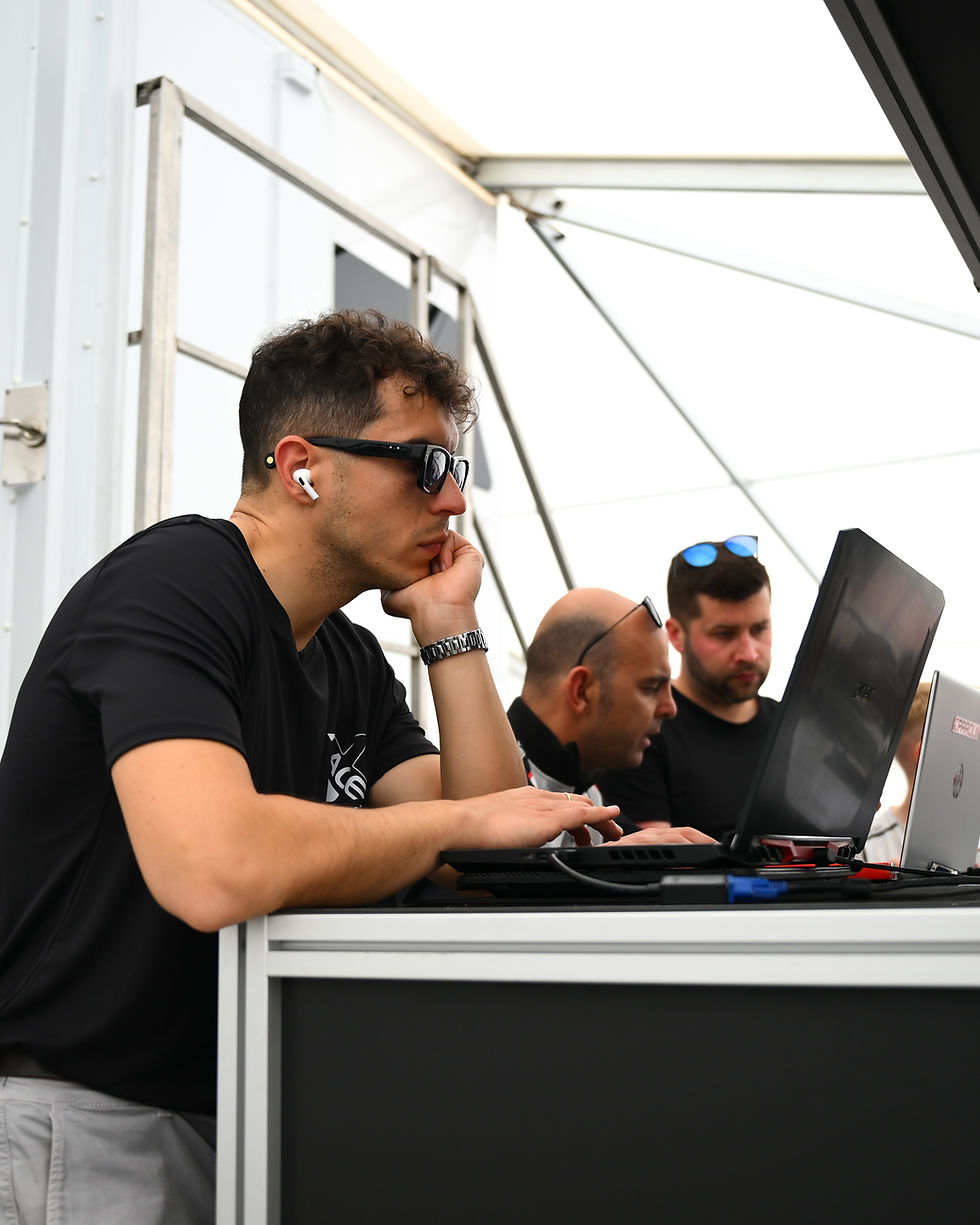
At the Lab, when we analyse telemetry with a driver, we always start with the same three elements, the easiest to read, even for someone who has never seen a telemetry graph.
The speed trace
The first is the speed trace. It shows where you slow down and where you accelerate, and above all where you lose speed compared to the optimal reference.
Often the problem isn't easy to spot, as people tend to fixate on braking, when in fact the margin lies in the acceleration on corner exit: getting back on the throttle too late, or too cautiously, carries that lost speed all the way down the following straight.
Laps and references
The second is the lap overlay. Comparing two laps by the same driver, or the driver's lap against a reference, makes it possible to see exactly where on the circuit the laps diverge, and where the final delta comes from: a tenth lost at corner three, three tenths recovered on the straight.
This is where you see that time isn't lost evenly across the lap, but concentrated in a few precise points, margins that would be impossible to analyse by watching onboard footage alone.
Braking
The third is the braking point. Where you start braking, how hard, for how long. It's one of the hardest elements to perceive from inside the car, and one of the easiest to read in the data.
Those who are convinced they always brake at the same point often discover that it varies by a few metres from one lap to the next, and it's precisely that variability that makes lap times unpredictable.
What makes telemetry so important
Working with telemetry transforms the way you train. You stop looking for improvement by feel and start driving with a precise objective. You go from "I need to brake later" to "I need to move my braking point by five metres at corner seven".
At the Lab we use telemetry as a coaching tool, pairing it with our sessions both as pure analysis aimed at improvement and as an opportunity to learn to read your own data independently.
Want to learn how to read your lap data? Find out more.


Comments